We seek essays that do more than summarize existing debates. We are interested in interventions: texts that think with, against, or beyond inherited forms of critique, and that take seriously the question of what critique can still do.
Submissions from established scholars, early-career researchers, independent writers, workers and students are equally welcome.
Submission information
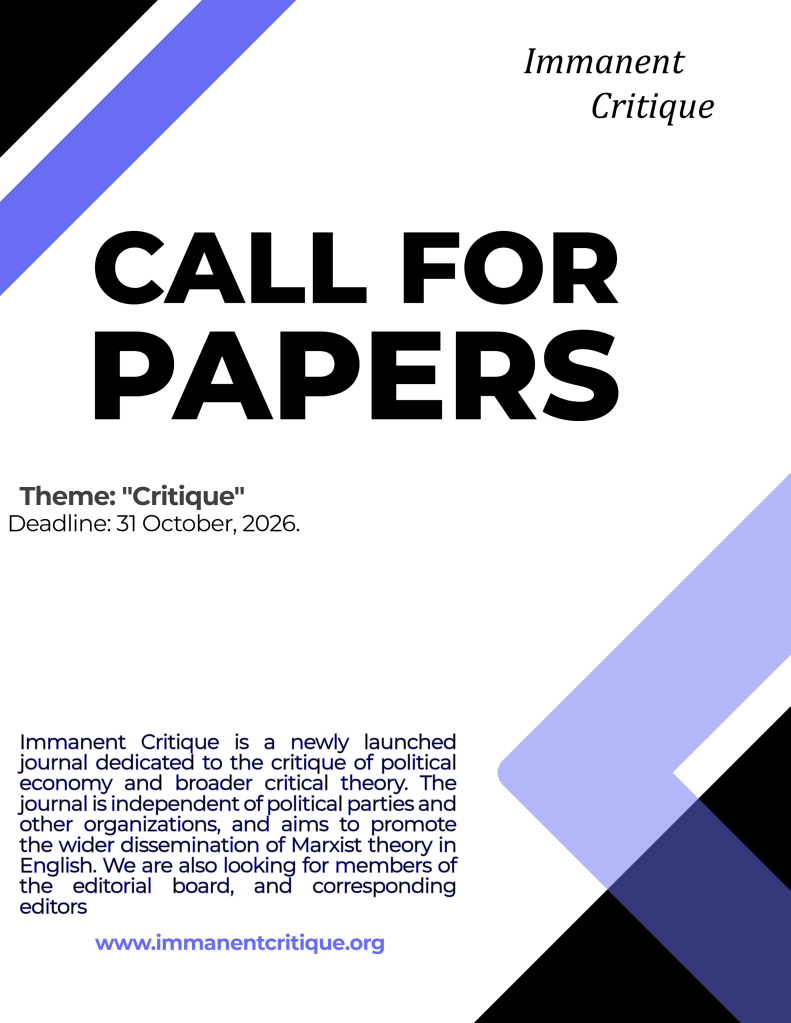
- Deadline: October 31, 2026
- Length: No maximum, though texts over 8,000 words are discouraged unless necessary
- Language: English, in any variety
- Please use footnotes and follow Chicago style
- Please submit manuscripts through the form below
Call for Papers
Immanent Critique Issue 1: Critique
What is critique?
Critique has long been philosophy’s privileged gesture. It names a practice of judgment, negation, clarification, exposure, interpretation, and transformation. It has promised emancipation, but has also been accused of paralysis; it has dismantled illusions, but has itself become a target of suspicion. If critique once sought to reveal what lay hidden beneath appearances, what remains of that ambition in a moment when everything seems already exposed?
The inaugural issue of Immanent Critique invites contributions that engage with critique as concept, method, historical practice, or political problem. Rather than assuming a single tradition or definition, we are interested in the tensions that constitute critique itself. Is critique primarily negative, or must it also construct? We also invite critique of objects that are not critique itself, such as the critique of political economy, critique of the State, or of a specific political tendency, movement etc. Can critique remain immanent to its object, or does it inevitably rely on external standards? What distinguishes critique from commentary, denunciation, or interpretation? What becomes of critique in the age of permanent emergency?
We welcome contributions that work across philosophical traditions and disciplinary boundaries. Possible topics include, but are by no means limited to:
- the history and genealogy of critique
- immanent critique and its traditions
- Marx, Kant, Hegel, both “Western Marxisms” Frankfurt School, poststructuralism, contemporary critical theory, and “Eastern Marxisms” be that Orthodox Marxism, Leninism, Left-Communism or others.
- critique after post-critique
- aesthetic, literary, or artistic critique
- political critique and forms of resistance
- ideology critique
- critique and crisis
- feminist, decolonial, ecological, or queer critiques
- the limits, failures, or future of critique


Call for Editors:
If you are interested in joining our editorial board as a regular editor (helping us organize the production of the paper), or corresponding editor (helping us review submissions after the deadline) do use the following contact form and tell us a bit about yourself.

